Steam, Suds and Sightlines: Signing a Live Brewery and Taproom
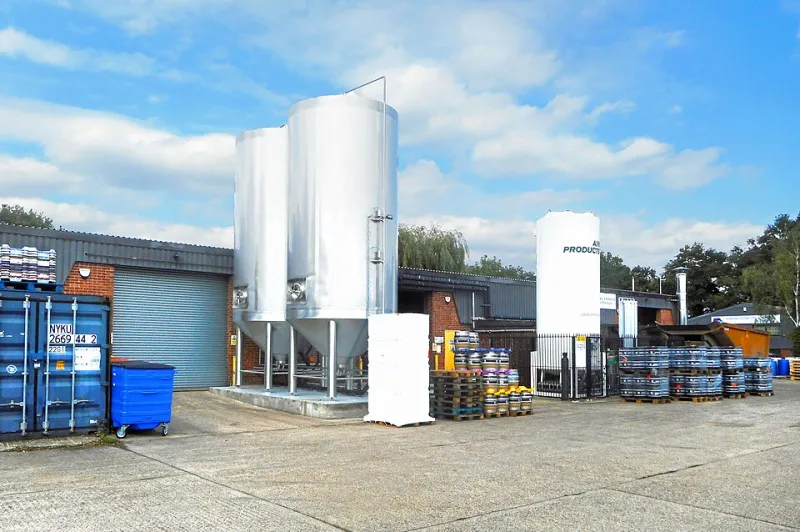
Photo: Des Blenkinsopp , CC BY-SA 2.0, via Wikimedia Commons
Breweries are awkward clients in the best possible way. The building is a factory on Monday, a visitor attraction on Saturday, and a function room on Sunday afternoon. The same corridor might see a forklift, a tour group and a cask washer before lunch. Signage has to keep up without looking like it belongs in a distribution centre.
That tension is where sandblasting earns its place. You get permanent, tactile lettering that can handle a hose-down, plus glass etching that separates the taproom from the brewhouse without blocking the one thing every brewery wants to show off: the kit.
Start With the Water, Not the Logo
Before anyone sketches a wordmark, walk the site and count the wet zones. Brewery washdown is not a gentle wipe. It is hot liquor, caustic, peracetic acid, and a hose with a trigger. Condensation sits on cold steel overnight and drips onto anything mounted below.
That rules out a few favourites from the high street. Mild steel will bloom at every fixing hole. MDF and birch ply will swell, even powder-coated. Standard vinyl applied to a damp wall will lift at the edges within a season.
The dependable palette is narrower than you might think:
- 316-grade stainless for plates in the splash zone, ideally bead-blasted or brushed rather than mirror-polished.
- Anodised aluminium with a good powder coat for larger panels away from direct spray.
- Toughened glass for internal screens and taproom partitions.
- Solid-grade HPL or exterior-grade composite for temporary tour signage.
If a sign needs to be illuminated, specify an IP65 rating as a minimum in the brewhouse and make sure the cable route is designed by someone who has seen the ceiling. A junction box perched above a boiling kettle is a future call-out.
Two Climates Under One Roof
Treat the brewhouse and the taproom as separate briefs. The brewhouse needs low-glare, high-contrast plates that read through steam and can be scrubbed. The taproom can afford warmth, finer letter edges and a bit of drama.
That split also helps with wayfinding. Use one visual language for production and another for guests, then join them with a consistent typeface. A visitor should be able to tell, at a glance, which door leads to the toilets and which leads to the fermenters. A contractor should not have to guess.
Staff doors deserve particular attention. In a busy brewery, the unglamorous doors get the most traffic and the least design thought. Give them clear, blunt labels, mounted at eye height, with a consistent colour band. Sandblasted stainless or powder-coated aluminium works well because it survives constant contact and cleaning.
Briefing Around the Brew Day
This is the part that separates a smooth installation from a week of apologising. Breweries do not stop for sign fitters. They stop for nothing much at all.
Ask for the production calendar before you quote. Good times to survey and install are usually cask-wash days, transfer days, or the quiet window before a big delivery. Bad times are packaging runs, brew days and anything involving a tank drop.
Most of the blasting should happen off-site. Bring finished plates and a fitter, not a compressor and a cloud of grit. If any on-site blasting is unavoidable, agree containment, extraction and a hard stop time in writing. Nobody wants a fine dusting of aluminium oxide settling on an open fermenter.
Also agree who is isolating power for illuminated signs. Brewery electricians are busy people and their schedules move. A sign that is 90 per cent fitted because the spur was not ready is a sign that will be 90 per cent fitted for three weeks.
Etched Glass That Earns Its Keep
Taproom glass is where breweries get the most value from sandblasting. A frosted band across a screen gives you privacy without shutting out daylight. A sandblasted logo in the corner of a window gives you branding that cannot be peeled off after a late night.
A few practical points:
- Etch depth matters more than people expect. A shallow cosmetic frost looks patchy under low winter light. A proper etch, typically in the region of 100 to 150 microns, reads evenly.
- Manifestation is not optional. If you are glazing a screen that people might walk into, building regulations expect markings that are visible. Use the etching as the manifestation rather than adding stickers later.
- Gradient and banded etches hide fingerprints better than a full frosted panel. They also let more light through, which matters in a taproom that is trying to feel open in February.
- Backlit etched glass can look superb, but plan the light source and access panel before the glass is ordered.
For a brewery, the best use of etched glass is usually a waist-to-head-height band along the brewhouse screen. It hides the messiest parts of the process from seated guests and keeps the shiny tanks visible above. That is a design decision as much as a signage one, and it is worth agreeing early.
Fixings for Damp Corners
A brewery is a hard place for metal. Condensation, cleaning chemicals and warm, humid air will find any weakness.
Use stainless standoffs and stainless screws, not plated ones. Specify isolation washers where aluminium meets steel to slow galvanic corrosion. Fix into the substrate, not into a timber batten that will rot behind the panel. In older brewery buildings, that may mean a site visit with a hammer drill and a cup of tea before anyone commits to a fixing detail.
For glass, use structural silicone or properly rated clamps, and leave room for movement. Industrial buildings flex. Glass does not.
A Sign Plan for Tours, Deliveries and Staff
Good brewery wayfinding has three audiences and three heights. Tour guests read at eye level and want charm. Delivery drivers read from a cab and want a big, plain word and an arrow. Staff read in a hurry and want the door labelled the same way it is labelled in the induction pack.
Sort those three layers before you get attached to a typeface. The rest is craft, and craft is the easy part.